Our website uses affiliate links. If you click through any of these affiliate links in this article to make a purchase, we may earn a small commission at no extra cost to you. As Amazon Associates, we earn from qualifying purchases. Read our Disclosure for more. Thanks for your support!
After visiting Naxos several times during the last couple of decades, we crafted this Naxos itinerary with tips for a smooth road trip across the largest island of the Cyclades.
An island that has managed to remain authentic to its core despite its high popularity in recent years, Naxos is known for its delicious food, rich ancient history, beautiful beaches, and insanely picturesque villages.
Keep reading to find out how to plan the best Naxos itinerary by car if you’re visiting the island for the first time.

If you’re considering a trip to our home country soon, we’re here to answer all your questions.
Click here to book a 60-minute video call with us or purchase a travel planning bundle that consists of a video call and a Greece itinerary, customised to your travel needs and desires.
Learn more about our travel planning services.
Where Is Naxos?
Naxos is the largest island of the Cyclades with long sandy beaches and high mountains.
The closest islands to Naxos are Paros, Ios and Amorgos, as well as the complex of Small Cyclades that comprises Iraklia, Donoussa, Koufonissia and Schinoussa.

Do I Need a Car in Naxos?
Yes, you need a car in Naxos to fully enjoy the island and visit places beyond the main towns and sights.
Distances in Naxos are pretty long, while some of the best beaches, villages and attractions are hard to reach by public transport.
However, if driving is not an option for you, there are ways to see Naxos’s main attractions by public transport and guided tours.
Benefit from our travel planning services to help you out planning your trip to Naxos without a car.
Driving in Naxos
Road Network in Naxos
As in most Greek islands, Naxos features a wide network of provincial roads. Roads are generally in good condition.
However, there are no such things as highways or toll stations on the island. All roads are one-lane, narrow and most of them winding.
To visit some remote places or beaches, you might need to drive on a dirt road or through a mountain pass.
Most mountain roads are winding, but there are safety bars almost everywhere. The only route you’ll need to pay more attention to is the steep road that leads to Moutsouna.
Greek Drivers
Local drivers often rush things on the road by driving fast and overtaking slower vehicles. As long as you follow the rules and drive with caution, you’ll be more than fine.
Gas Stations in Naxos
There are several gas stations in Naxos, with most of them located along the provincial road just outside Naxos Town. Keep in mind that fuel is always more expensive in Naxos and the islands than on the mainland.
All gas stations in Naxos are serviced and some of them stay open until late at night.
Parking in Naxos
Parking spaces are limited in Naxos Old Town and the surrounding area, such as Agios Georgios Beach.
Elsewhere on the island, parking should not be a concern. There’s always a large parking lot in the villages and near the beaches.
What Type of Car Should I Rent in Naxos?
The roads in Naxos are winding and narrow and most of the time you need to cover long distances or drive on dirt roads.
While planning your Naxos itinerary, look for a rental car small enough for easy parking and navigating the narrow roads, yet powerful for mountain driving and tall enough to handle dirt roads comfortably.
Keep in mind that most rental cars have a manual transmission.

When Is The Best Time To Visit Naxos For a Road Trip?
The peak season in Naxos coincides with the Greek school summer holidays from late June to early September. Especially August is a month you should avoid when planning your trip to Greece.
Naxos is an island many Greeks visit in the summer months, so expect limited parking, traffic, crowded beaches, and long queues at restaurants.
The best time to visit Naxos is May, early June, late September and early October.
These are the perfect months for a road trip across Naxos, as traffic is lighter and parking in Chora is easier.
Visiting during these times allows you to enjoy the island life, relax on the beaches, and hike without the discomfort of excessive heat.

How Many Days in Naxos?
Naxos is by no means a weekend break destination.
To see the island’s ancient ruins, relax at the sandy beaches, visit the traditional villages and enjoy the delicious local food, we recommend staying in Naxos for six full days.
This Naxos itinerary is crafted to fully enjoy the island and have time to relax in 6 days. However, if you’re short on time, don’t hesitate to book a call with us to help you plan your trip to Naxos.

How To Get To Naxos
By Air
To fly to Naxos from abroad, you need to first fly to Athens, as there aren’t any direct international flights to Naxos. Depending on the season, there are also domestic flights to Naxos from Thessaloniki and Crete.
Naxos has a small airport, a 10-minute drive from the Old Town. Public buses run regularly from Naxos airport to Naxos Town in the summer months.
Alternatively, book a private transfer to get directly to your hotel in the most relaxing way.
By Ferry
Taking the ferry from Piraeus Port is the most common way to get to Naxos year-round. During high season, ferries might also run from Rafina Port.
Journey times vary depending on the ferry type. It takes about three and a half to four and a half hours on a high-speed ferry or five to six hours on a regular ferry from Piraeus to Naxos.
Naxos is well connected to other Cycladic islands, especially in the summer. Consider adding a nearby island to your Naxos itinerary, such as Santorini, Paros, or Amorgos.
However, we recommend adding to your Naxos itinerary one of the Greek islands where you don’t need a car to relax and decompress from driving, like Donoussa or Iraklia.
Our guide on which Greek island is ideal for you will help you plan a Greek island-hopping itinerary.
The best way to check ferry routes and timetables, as well as to buy our ferry tickets, is through Ferryhopper.

Where To Stay in Naxos For a Road Trip?
The island of Naxos is abundant in top-quality accommodation options that range from boutique hotels to fully serviced apartments.
Although parking can be tricky in the high season, one of the best places to stay in Naxos is Chora and the area around Agios Georgios Beach.
Our favourite hotel is the Galini Hotel on Agios Georgios Beach.
Conveniently situated right next to one of the largest parking lots in Chora, Galini Hotel offers impeccably clean, smartly decorated rooms with amazing views of the Aegean Sea and the quaint chapel of Agios Georgios.
If you prefer to experience the local life of Naxos, rather than the beaches, consider staying at one of the island’s picturesque mountain villages that will facilitate your hiking or driving trips across Naxos.
Filoti, a vibrant village at the foot of Zas Mount, is a good base for a Naxos road trip.
An easy walk from the main square of the village, Dreamcatcher of Zeus features the most home-away-from-home rooms in Naxos. Built in traditional style, these rooms in Filoti will make you feel at home in Naxos.

Watch Our YouTube Video About The Best Things To Do in Naxos
Travel Resources To Help You Plan The Best Naxos Itinerary By Car
Naxos Itinerary – The Perfect Slow Road Trip in 6 Days
Day 1
Bazeos Tower
On your first day in Naxos, start early in the morning and leave Naxos Town behind to hit the road to explore the rest of the island.
First, head to Vivlos village to admire its quaint windmills and then make your first stop at Bazeos Tower.
The 17th-century Bazeos Tower is a fine example of a restored typical tower of Naxos that dominates the surrounding landscape. Bazeos Tower used to be the Holy Cross (Timios Stavros) Monastery.
After the last remaining monks abandoned it in the early 19th century, Bazeos Tower hosted several families of potters.
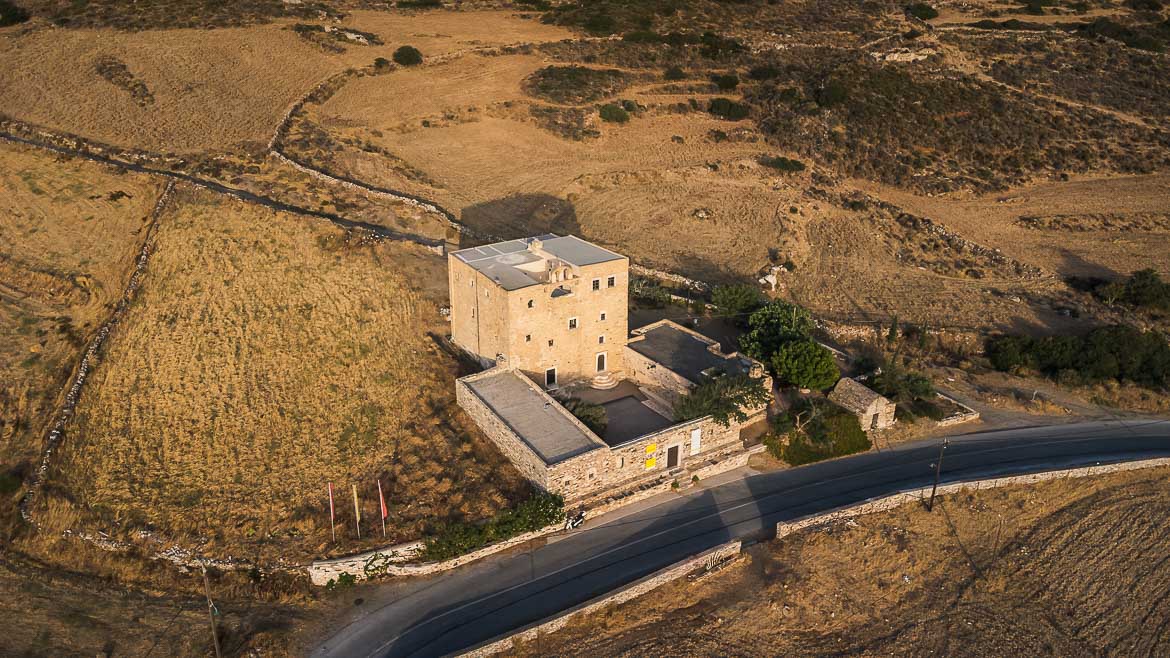
Nowadays, you can visit the tower to see what the interior of a Naxian tower looks like. In the summer months, Bazeos Tower hosts the renowned Naxos Festival, one of the island’s greatest cultural events.

Temple of Demeter
A 10-minute drive from Bazeos Tower is the hilltop Temple of Demeter, one of the best archaeological sites to visit on the island.
The 6th-century BC temple was dedicated to the ancient goddess Demeter and her daughter Persephone. In the 6th century AD, the temple was demolished and a Christian basilica was built with the same stones.
The archaeological site is very small and easy to explore. There is also a small archaeological museum displaying findings from the excavations.

Aliko Beach
It’s time to head to the western coast. A half-hour drive from the Temple of Demeter is Aliko, an area renowned for its natural beauty.
Aliko is home to the largest cedar forest in Greece and comprises several small bays with turquoise waters and impressive sand dunes. Next to Aliko Beach, you can enjoy the more exotic-sounding (and looking) Hawaii Beach.
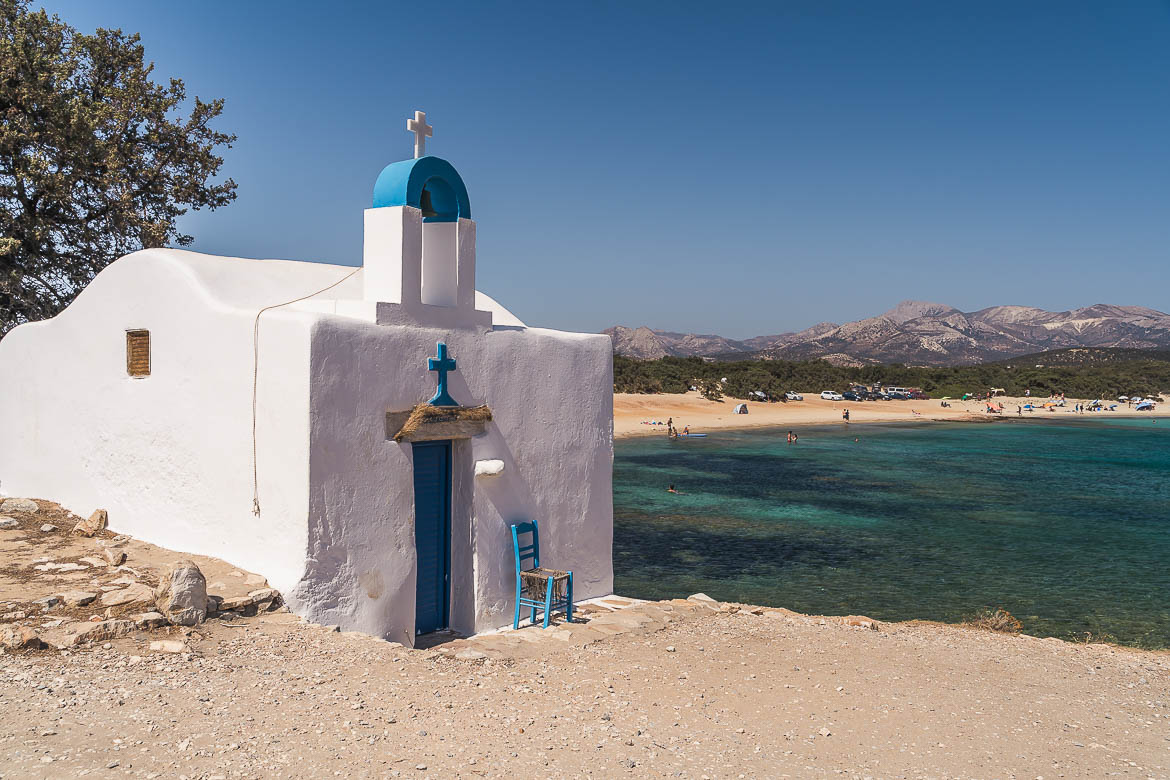
There’s yet another reason to visit Aliko. Right above the beach, there’s a large hotel complex that was never completed and has been abandoned for decades.
As of late, the abandoned hotel has become a favourite with street artists who have turned its grey walls into masterpieces.
Among the drawings, you can find some signed by WD (Wild Drawing), such as The Third Eye, probably the most impressive piece of street art in Aliko.
While walking around the abandoned hotel in Aliko and the surrounding area, make sure you watch your step because there are many holes in the floor.
Also, don’t spend too much time inside the buildings as there’s always the risk of falling parts.

Taverna Axiotissa
A short drive from Aliko, Taverna Axiotissa is the best place to end your first day in Naxos. Enjoy Greek dishes with a twist made with local products in a charming setting.
Don’t forget to make a reservation, as Axiotissa is one of the most famous restaurants in Naxos.
Day 2
Flerio Kouros Statues
Start your second day with a short drive to the Flerio archaeological site to learn everything about the ancient marble quarries of Naxos. The parking area is a short walk from the ancient site.
In ancient times, the island’s top-quality marble was used in sculpture and architecture. Local craftsmen of the time would give the sculptures their rough shape on-site at the quarries.
The final details would be carved after each work of art had reached its final destination. This was done to prevent damaging the sculpture during its transfer from the quarry to its final destination.
Accidents during the transfer weren’t uncommon, though. Therefore, whenever a sculpture was damaged, it was abandoned at the quarry.

Other reasons why sculptures were left at the quarries were order cancellations or various political events.
Among the most interesting attractions in Naxos are the Kouros statues that were abandoned at the island’s ancient quarries.
Kouros is the Ancient Greek word for the statue of a standing, often naked, young man.
There are three Kouros statues scattered across Naxos. Two of them are in the archaeological site of Flerio. You’ll see the third one on a different day.
Each of these two statues depicts a young man of supernatural size (5.5 metres tall). Both Kouros statues were carved at the same quarry and later abandoned after the legs broke during transport.
The two Kouros statues of Flerio are within a short walking distance of one another.

Sanctuary of The Springs
Just a few steps from the parking area, don’t miss the nearby Sanctuary of the Springs. It’s free to visit and it provides great insight into the importance of this area in ancient times.
Situated in the lush Flerio area, the sanctuary was dedicated to a female deity connected to the fertility of the soil.
It was also a favourite place of worship for the workers at the nearby ancient quarries.

Mili Village
A 15-minute walk or a few minutes’ drive from Flerio is Mili, a charming small village in the mountains. This picturesque village is perfect for a leisurely stroll amidst lush greenery and running streams.
While you’re there, make sure to visit probably the most beautiful café in Naxos. If it’s open, it’s an excellent spot to relax with a coffee and enjoy a few small plates.

Agios Prokopios Beach
Head back to the west coast to relax at the most popular beach in Naxos.
With crystal-clear, shallow waters, golden sand, and three pink salt lakes that lend it an exotic touch, Agios Prokopios is graced with utter natural beauty.
Sadly, sunbeds and umbrellas have taken over the beach and it can get unbearably crowded during the high season.
For fewer crowds, try to pick a spot on the beach that’s as far from the village as possible. As a rule of thumb, the closer you are to this spot, the better.

Dinner at Chora
Spend the evening in Chora and enjoy dinner at a traditional restaurant in the modern part of town. Maro’s Taverna is one of the best restaurants to taste local traditional dishes in Naxos.
You’ll know you’re in the right place when the friendly staff offers you complimentary wine while you wait for your table. Keep in mind, the portions here are generous.
Maro’s Taverna specialises in meat-based dishes, but there are a few vegan options available. You can also ask the staff for an improvised vegetarian dish if you prefer.
Day 3
Eggares Olive Press Museum
On your third day, start early in the morning and embark on a long scenic road trip to the north of the island. Make your first stop, a 15-minute drive from Naxos Town, at the nearby Eggares Village.
Dating back to the 1800s, the local Olive Press Museum is a great place to learn the secrets of traditional olive oil making during an enlightening guided tour of the small museum, followed by an olive oil tasting.
After the tour, you can relax at the on-site café or drop by the museum shop to buy top-quality local products.
Agia Tower
Before reaching the Apollonas village, after one hour drive from Eggares, make a quick stop at Agia Tower, probably the most eye-catching of all abandoned towers in Naxos.
It’s worth stopping for its splendid architecture and unique position, which offer a beautiful view of the Aegean Sea.
It’s easy to walk to the tower from the main road via a few stone steps. The tower was largely destroyed by a fire in 1992. You can’t go inside, yet you can still sense how grand it must have looked in its heyday.

The Kouros of Apollonas
A 15-minute drive from Agia Tower, not far from the Apollonas village, is the third and probably most impressive of all three Kouros statues in Naxos.
The Kouros of Apollonas is the statue of an old man who’s more than ten metres tall, left at the ancient quarry near Apollonas Village. Scientists disagree as to which Ancient God it depicts. Is it Apollo or Dionysus?
The Ancient Quarry of Apollonas is a site of great significance. That’s because it was the main source of marble for the Holy Sanctuary of Delos.
The site is free to visit all day long. Sadly, there isn’t even a rope to keep people from stepping on the ancient Kouros statue.
Please refrain from stepping, lying or sitting on the statue when you visit the Kouros of Apollonas.
Before continuing your road trip, take a short break in Apollonas village for a quick swim and a refreshing drink. Trust us and go for lunch at the next stop.

Koronos Village
Within a 25-minute drive through a scenic mountain pass, you’ll reach one of the lesser-known mountain villages in Naxos.
Unlike the glorious Apeiranthos with its impeccable looks, Koronos has a rugged quality that renders it beyond words charming.
Koronos is one of the oldest settlements in Naxos, built on the slopes of a dramatic ravine. This whitewashed dream of a village used to be the capital of the mountainous region of Naxos.

It’s divided into seven neighbourhoods, each with its own square and old water fountain. The village’s main square is called The Platsa.
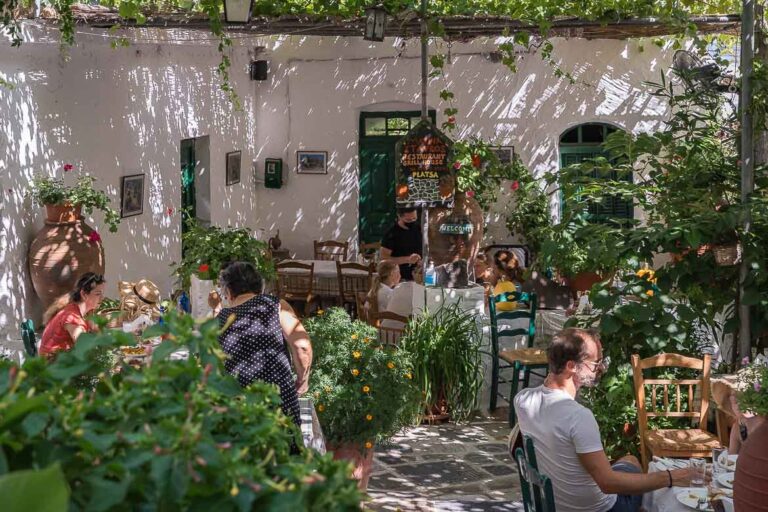
Enjoy your lunch at Matina’s Taverna, which serves some of the best Greek vegetarian dishes we’ve tried in a wonderful setting, and thank us later.
Keep in mind that walking around the village involves going up and down several flights of stairs and uphill alleys.

Moutsouna
Your last stop is Moutsouna, a seaside village on the east coast of Naxos, a half-hour drive from Koronos. Be aware that the last part of the route to Moutsouna is quite steep, so drive carefully.
Moutsouna is a small seaside village with a rich history, related to the island’s abundance of emery, yet another valuable raw material produced in Naxos alongside marble.
Moutsouna is home to the island’s only natural port. From there, emery was shipped worldwide during the island’s emery mining peak, from the late 19th century until the early 1980s.
The most fascinating sight along the route to Moutsouna is the old aerial cableway used to transport emery from the mines to the port of Moutsouna.
The aerial cableway was constructed in the 1920s to replace the poor donkeys that were burdened with the task of carrying the emery up and down steep slopes under the scorching sun.
The old aerial cableway is considered an engineering wonder of its time and it changed the landscape of northeastern Naxos forever.
The most impressive remnants of the old emery aerial cableway are located towards the end of the route, near Moutsouna.

Nowadays, you can see the impressive old loading ladder while sitting in the shade at one of Moutsouna’s cafés and restaurants or swimming in the incredible waters of the village’s small beach.
To get back to Naxos Town, it’s one hour drive from Moutsouna.

Day 4
Filoti
Start your day heading back to the mountain villages. This time, your first stop is Filoti, the largest village in Naxos, a half-hour drive from Naxos Town.
Built on the slopes of two hills at the foot of Mount Zas, Filoti features a lively square perfect for coffee and breakfast with locals and visitors alike.
Some of the best things to see in Filoti include the imposing Barozzi Tower and the gorgeous 17th-century Church of Panagia Filotitissa.
The village of Filoti is also where the greatest traditional feast (panegiri) of Naxos takes place on August 15th every year, with dancing and singing going on for three consecutive days.

Aries Spring and Zas Cave
A short drive from Filoti, the scenic Aries Spring is a great spot for a refreshing break.
Situated in a dreamy setting, under the shade of a century-old plane tree, Aries Spring is where you can refill your bottle with freshwater from the mountains, perfectly safe to drink.

Aries Spring is worth a visit in its own right. That said, it’s also near the starting point of a fascinating hiking trail that leads to Zas Cave and the summit of Mount Zas.

Zas is another name for Zeus, the ancient king of the Olympian Gods. Legend has it that Zeus was raised in a cave in the mountains of Naxos.
In his honour, the cave became an important sanctuary where Zeus was worshipped and the locals named the highest mountain in the Cyclades after him.

Monastery of Fotodotis
Your next stop on your way to the island’s south is a 20-minute drive from Filoti. Built in a location of rare natural beauty, the Monastery of Fotodotis is the oldest fortified monastery in Naxos.
The monastery looks like a fortress when you look at it from the outside. However, when you step inside, the peacefulness of the shady courtyard that leads to the church leaves no room for doubt.
The church itself is a sight to behold. Its most striking features are the colourful marble templon and the chapel of Saint Nicholas on the right side of the church.
The upper floor is dominated by the church’s dome, which is surrounded by the monks’ cells.
Keep in mind that the dirt road that leads to the Monastery of Fotodotis is in a rather terrible condition. Therefore, be extra careful while driving.
Alternatively, leave the car before the road gets bumpy and walk uphill to the monastery.

Panermos Beach
Continue your road trip to the east coast of the island until you reach Panermos Beach at the south. The drive from Fotodotis Monastery to Panermos takes about one hour.
On your way, you’ll pass numerous sandy beaches, but we recommend Panermos, as it’s a small beach, protected by strong northern winds, with shade and a small canteen for snacks and drinks.

Apeiranthos
Drive back all the way to make your last stop at Apeiranthos, the most famous village in Naxos, for a reason.
Apeiranthos – also spelt Apiranthos, Aperathos or Aperathou. Apeiranthos is the second-largest village in Naxos, built in the 10th century by Cretans.
Often called “The Marble Village”, Apeiranthos feels like an open-air museum with its marble mansions, streets and squares.
Moreover, Apeiranthos is famous throughout Greece for being the birthplace of Manolis Glezos, a WW2 hero of the Greek Resistance, known for taking down the Nazi flag from the Acropolis in 1941.

Even though Apeiranthos is a small village, it’s home to several museums, which is quite impressive.
Probably the most striking thing to see in Apeiranthos is the Tower of Zevgolis, which stands in all its grandeur at the entrance of the village.
You can admire the tower from the outside alone, as it’s private property, not open to the public.

On your way back to Naxos, Rotonda is a popular spot to enjoy the sunset with drinks or dessert.
Day 5
Panagia Drossiani Church
Start your day 5 in Naxos from Panagia Drossiani Church, one of the oldest churches on the island, a half-hour drive from Naxos Town.
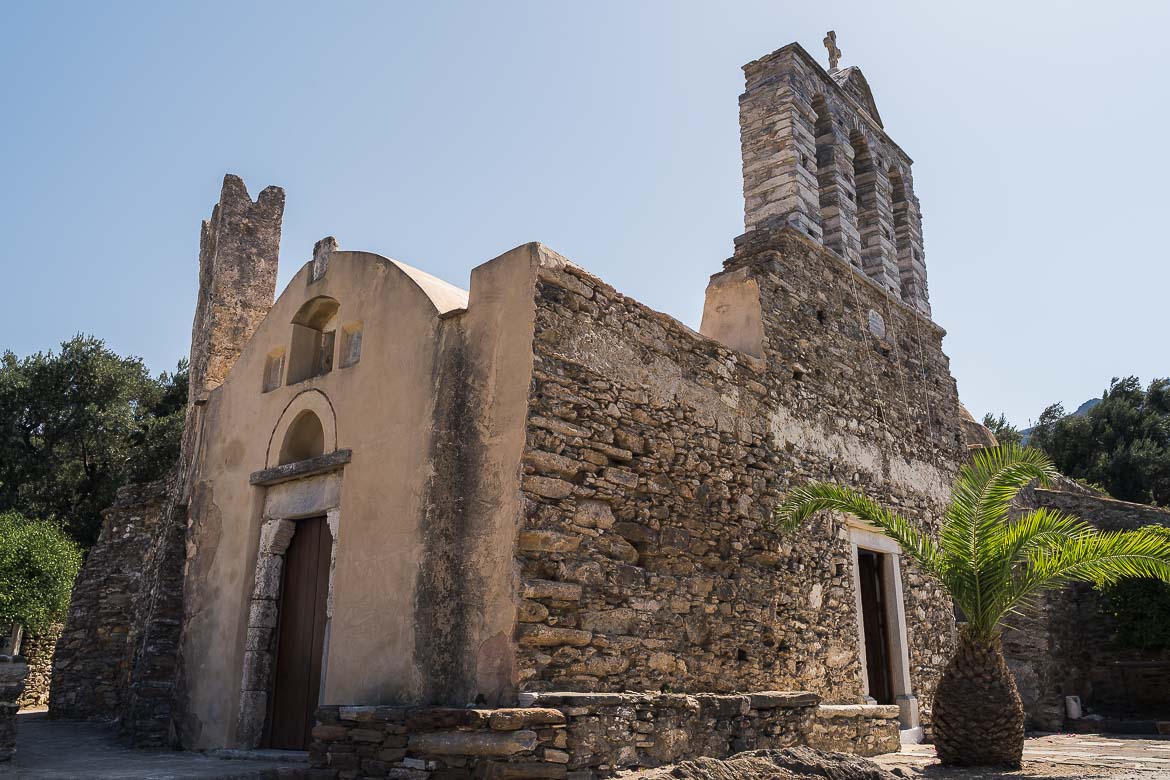
Dating back to the 6th century and home to some of the oldest frescoes in the Balkans, the Church of Panagia Drossiani is one of the prettiest attractions in Naxos.
The church features a spectacular interior and a quaint courtyard.
Outside the church, local ladies sell handmade table linen and other loom-woven items.
Chalki Village
Within a short drive from Panagia Drossiani Church, Chalki is a tiny village in the heart of Naxos. However, due to its location, Chalki has always been a major administrative centre.
The village’s architecture testifies to its past grandeur and wealth. Chalki is home to marvellous neoclassical mansions, quaint alleys and picturesque squares.

While strolling around Chalki, make sure to see the 9th-century Church of Panagia Protothroni and the 17th-century Barozzi-Gratsia Tower.
Don’t miss the opportunity to stop by Vallindras Distillery, one of the island’s oldest citron liqueur distilleries, established in the 19th century.
A must-try is the galaktoboureko at Kafeneio Galani, a delicious Greek dessert made of custard pie topped with syrup.

One of the best things to do in Chalki is to walk along the circular hiking path 4 that starts and ends in the village. During this walk, you can admire gorgeous Byzantine churches scattered across a lush green area.
If you don’t feel like walking the entire length of the path, you can just enjoy the short walk to the 11th-century church of Agios Georgios Diasoritis and back.

Agios Georgios Beach
Head back to Naxos Town and spend the rest of the day relaxing at Agios Georgios Beach.
Agios Georgios is a sandy beach in Chora with beach bars, restaurants, sunbeds and umbrellas. It’s a good option if you’re staying in Chora and leave your car behind for the day.

Day 6
On your last day, in the morning, explore Naxos Town or Chora, where the heart of the island beats.
The main town comprises the promenade that leads to the Ferry Port of Naxos and Portara, the Old Town, the Castle of Naxos, the Grotta area, the modern part of Naxos Town and Agios Georgios Beach.

Start your exploration from Portara, the very symbol of Naxos. The gate is the only remaining part of the unfinished Temple of Apollo that stood there in ancient times. You can get to Portara via a lovely paved path from Chora.
Although Portara is one of the best sunset spots in Naxos, we recommend visiting early in the morning and then enjoying a dip in the sea that’s right below the archaeological site.
Portara has no entrance fee and it’s open to visitors all day long.

Continue your walk to the Grotta neighbourhood, popular for its picture-perfect beach.
Moreover, in Grotta, you can visit the Orthodox Cathedral of Naxos and the Archaeological Site of Grotta with its display of findings that date back to the Bronze Age.

From Grotta, explore the Old Town of Naxos or Bourgos, built outside the walls of the Venetian Castle of Naxos.
Get lost in its maze-like alleys and find the Old Market of Naxos, home to local shops perfect for buying some of the best Greek souvenirs to bring back home.
The Castle of Naxos is part of Chora, which was built by the Venetian Marco Sanudo in 1207.
The fortified settlement has remained inhabited ever since, its medieval beauty reflected in glorious mansions and enchanting courtyards.

One of the best places to visit in Naxos Castle is the Roman Cathedral, a splendid marble church that stands at the Castle’s main square.
Near the Roman Cathedral, you can visit the Archaeological Museum of Naxos, the Della Rocca Barozzi Venetian Museum and the Church of Panagia Theoskepasti, probably the oldest building inside the Castle of Naxos.

Yet what dominates the Castle of Naxos is the former complex of the Ursuline Nuns School. It comprises many buildings, most of which are now renovated and used as cultural and educational centres.
One of them houses Avaton, a rooftop bar with great views. In Avaton, you can have a look at what the Ursuline School must have looked like back in the day, when it was filled with young girls’ laughter.

After your exploration of Naxos Castle, the charming promenade is the perfect place to sit back and people-watch.

Manto Islet and Beaches at The West
Before heading to the west coast of the island, make a quick stop at the Manto Islet for a relaxing walk and fantastic views of Naxos Chora.
Explore the beaches on the western coast, which include Agia Anna, Plaka Beach, Mikri Vigla Beach and Kastraki, all of which feature beach clubs.

Chora For Sunset & Drinks
Spend your last evening in Naxos, starting from Grotta Beach, to enjoy a spectacular sunset with panoramic views over the Portara.
After sunset, wander around the narrow alleys of Chora to find the best bars for drinks in a perfect setting.
One of our favourite bars in Naxos is Notos, a rooftop bar under the shade of the Castle of Naxos, with romantic decor, serving cocktails made with citron liqueur.
Yet another is Naxos Café, a cosy bar with a local feel in a whitewashed alley in the Old Market, open all day for coffee, sweets and snacks.

We hope that our complete Naxos itinerary by car helps you plan your own trip to Naxos, this diverse island that has something for everyone, a slice of Greek paradise that guarantees a vacation to cherish for life.